



About
This is part of the klapt.net Internet presence by Kristina Lauche and Peter Troxler.
klapt is nothing indecent or anything ...
and klapt.net is not some bavarian slang that would mean: "this does not work".
It's just our initials and an and in between ... enjoy the site!
DutchNews titelt heute: “Fewer people move to the Netherlands as population growth slows” – naja, wohl eher umgekehrt.
Video: Netherlands Institute for Sound and Vision (http://archive.org/details/oi59416).
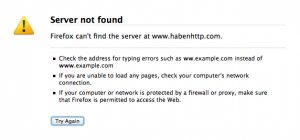
Für die ganz wichtigen, weil anti EU gerichteten Mitteilungen im sonst dürftigen “NZZ am Morgen” Newsletter hat die NZZ heute ein neues Internetprotokoll eingeführt: das “Haben statt Soll Protokoll”.
So wird zum Beispiel der Link http://newsletter.nzz.ch/re?l=ot5lbnI6zps6eeI7
automatisch umgesetzt nach “http://habenhttp//www.nzz.ch/meinung/debatte/flexibilitaet-eines-netzwerks–nicht-die-starre-eines-blocks-1.17958305?extcid=Newsletter_24012013_Top-News_am_Morgen”
Leider kämpft das Protokoll noch mit Kinderkrankheiten … wahrscheinlich ist der neue NZZ-Anit-EU-Protokollserver habenhttp.com völlig überlastet von der Vielzahl der Online-Aufrufe …
ETH Studie: “Vor vier Jahren entdeckten Forscherinnen und Forscher im Nordatlantik hydrothermale Felder mit vier Schwarzen Rauchern. Ein Tummelplatz für urtümliche Mikroorganismen, wie eine neue Studie zeigt.
http://www.ethlife.ethz.ch/archive_articles/121101_black_smoker_per/index
Ein “schwarzen Raucher” ist ein hydrothermales Feld – ein Riss in der Erdkruste, aus dem kochend heisses Wasser dringt. Unter Wasser entstehen kaminartige Strukturen wenn das heisse Wasser aus dem Erdinneren mit dem kalten Meerwaser in Kontakt gerät und die transportierten Mineralien ausfällen und zusammenpappen. Manche der Strukturen sind weiss, die Mineralien sind Barium, Kalzium und Silikat, andere schwarz, da ist Schwefel im Spiel. Auf diesen Spuren finden sich Mikroorganismen, und eine Theorie sagt, dass hier “Leben entsteht.” Weisse und schwarze Raucher können bis zu 40 Meter hoch werden, bevor sie wieder einstürzen. Die grössten Feinde der Raucher sind – Wissenschaftler.
Downloading … 2400% complete and counting

Running it it reveils 1 serious security issue — I’m using s different product than theirs. I think Mac Keeper is a joke, a bad one
Sie kann ja nichts dafür …

Mechtild Freiin v. Münchhausen: Hochwasserwarnung per Scheibenwischer

Graduate Software Engineering opportunities…..in Barcelona!
Graduate Software Engineering opportunities…..in Winterthur!
what a choice…
For years ‘innovation vouchers’ have been one of the Dutch government’s ways to fund ‘knowledge institutions’. Whoever had a brilliant idea could apply for a voucher that then could be exchanged against a few hours of officially accredited knowledge work by e.g. PhD students as long as the Uni got the dough. No more! said Dutch minister Maxime Verhagen (CDA) on 22 November. As of 2011, innovation is vouched no more in .NL-land — and gone are ingeniously engineered schemes like this one…
And it took the office in charge over a month to inform interested parties about the decision … “agentschap.nl” sent an email on 29 December last year.
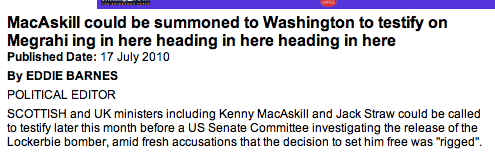
Scotsman online, 17 July 2010
Eddie Barnes at the Scotsman must have been in quite a hurry dashing this headline out: “MacAskill could be summoned to Washington to testify on Megrahi ing in here heading in here heading in here”
Want to buy a train ticket in Switzerland? Yeah, that’s possible … but hang on: don’t try to buy it in advance … the Swiss railways (SBB) have decided, that their customers are too likely to change their mind if travel is more than 30 days in the future. So you can’t buy a ticket for a journey more than 30 days away.
This is certainly straight stupid.
Interesting is the reason they give: “Da OnlineTickets nicht erstattet werden können, haben wir die Vorverkaufsfrist auf 30 Tage beschränkt. Denn je näher der Reisetag rückt, desto höher ist die Wahrscheinlichkeit, dass Sie die Fahrt auch wirklich antreten können.” — “Since online tickets cannot be refunded, we have reduced the sales period to 30 days before travel. Since the closer your day of travel, the higher the probability that you actually will be able to travel.”
This is a textbook example of bad service design (no refunds). Even worse: the service provider officially declares the customer the stupid party and makes the service even worse. The stupid one in this case is, once more the service provider, in this case the Swiss railways — and probably the Swiss in general who seem to be happy with this nanny treatment.
Public transport on Google Maps (Google Transit) … is available in Poland, Romania, Tunisia, even Italy, Spain, Portugal, the UK and Belgium — no surprise that Germany, Switzerland, France are covered.
But the Netherlands? A blank spot …
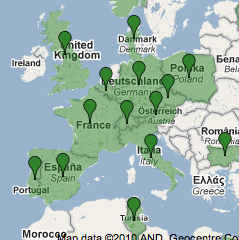
from Google Transit at http://maps.google.com/intl/en/landing/transit/#mdy
Aberdeen City Council sold its city centre to the oh so generous interests of Oil-rich “Sir” Ian Wood yesterday. Councillors agreed to spend £140m (of which Ian pays £50m, the remaining deficit has aptly been labelled as “business opportunity”) … on ebay

Aberdeen 4 Sale
No returns accepted.
in der Kohlenmine — als solche sehen sich 600 Schweizer Kulturschaffende: “In die unterirdischen Grubengänge von einst pflegte der Bergarbeiter einen Kanarienvogel mitzunehmen, der ihn bei Gefahr warnen sollte. Fing der Kanarienvogel an zu singen, war das ein Vorzeichen, dass Unheil in der Luft lag, Brandgefahr oder gar eine Explosion. — Wir, Künstler und Kulturschaffende, sind gleichsam wie der Kanarienvogel der Schweizer Gesellschaft, er singt, aber der Bergarbeiter ist so beschäftigt, dass er ihn nicht hört.”
Ein süsses Bild. Der Minenarbeiter Joe, in Edward Allan Faine’s Geschichte vom “Coal Miner’s Canary” hatte auch einen Kanarienvogel “he had trained to sing when there was trouble at the mine”. Und ich dachte immer, die Kanarienvögel seine schneller an Kohlenmonoxidvergiftung gestorben, als die Minenarbeiter, der Alarm sei also eher durch das Verstummen als durch alarmierendes Singen ausgelöst worden. Nun ja, “poetic license”. Doch wie kam wohl die “Alarmieren” Legende in die Kultur? … continue reading ‘Kanarienvögel’ »
Is this a bad sign for BP’s clean-up efforts in the Gulf of Mexico? Reading this report on the Beeb website, the message is all too clear:

This content doesn't seem to be working. Try again later.
Das ist der Titel der neusten Pressemitteilung eines Forschungsprojekt der TU Dresden und der Universität Potsdam. Man mache sich keine Sorgen um den Verstand der beteiligten Professoren, die Mitteilung wurde von einer Organisation zur Verbreitung der Online-Blindenschrift verfasst, die sich “Ergebnistransfer HyperBraille” nennt. Unter W2lkd10gQmxpbmRlIFBDLU51dHplciBrw7 ZubmVuIGpldHp0IEdyYWZpa2VuI OKAnnNlaGVu4oCc hat man sich ein “HyperBraille-Flächendisplay” vorzustellen, was wohl sowas wie ein computergesteuertes, variables Nippelmuster sein könnte …

HyperBraille Flächendisplay (c) hyperbraille.de
As airlines start bullying airtraffic controllers, eurocontrol becomes defiant on twitter: “For clarification: we do not take decisions as to whether to open/close airspace. Decision made by national authorities in each country” and “We’re responsible for ensuring that all involved, including airlines and ANSPs are then aware of decisions made by national authorities”.
Dutch KLM chiefs Peter Hartman and Ype de Haan believe, “there is no reason to suspect that anything is amiss.” Hear, hear, … so losing the odd plane might be cheaper for them than the virtual loss of 3.4 % in share prices?
Meanwhile, in Switzerland, the ash cloud has been measured and preliminary results are made public (including visualisations of original data). Pilots should now that their on-board radar does not pick up volcanic ash (otherwise they might re-check this instructional video produced by http://www.icao.int/).
PS: reports on a “near miss” of Ural Airlines trying to fly below the ashcloud and having to emergency land due to low fuel on (illegally?) open Vienna airport.
This is the current forecast for the ash cloud for 06:00 UTC on April 18th — the red curve shows the size of the cloud at flight level 100 (FL100, the pressure altitude in units of 100 feet). This means this is essentially a “no-fly-zone” for any height below approximately 3000 meters.
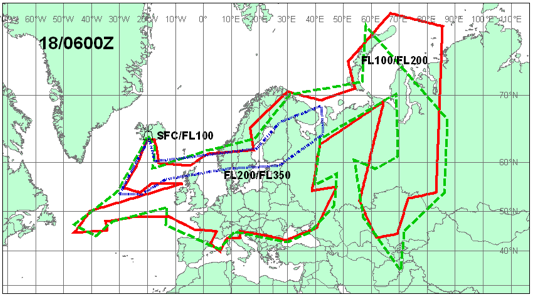
MET office -- ash cloud forecast for 18 April 0600 UTC (from: http://www.metoffice.gov.uk/aviation/vaac/data/VAG_1271508253.png)
And below is an excerpt of the official air space closures “VOLCANIC ASH – UPDATED AT 1600 UTC” collated by Eurocontrol — compare the “closed until” times with the forecast in the map. I am surprised how authorities create a climate of hope with these closure times (e.g. Netherlands: 18th, 0000 UTC) when it is obvious from the forecast, that the closure will be extended by probably another 12 to 24 hours. This is not only angering passengers, but aircraft operators as well.
Airspaces zero-rated/closed until:
(Aerodromes geographically located within these airspaces will be unavailable):EB Belgium 18-0600 UTC
EDGG Langen 18-0600 UTC
EDGG Dusseldorf 18-0600 UTC
EDWW Bremen 18-0000 UTC
EDMM Munich 18-0600 UTC
EE Estonia 18-0000 UTC
EF Finland 18-0000 UTC
EG UK 18-0600 UTC
EH Netherlands 18-0000 UTC
EI Ireland 18-1200 UTC
EK Danmark 18-0600 UTC
EN BODO South 18-0000 UTC
EN OS 17-2200 UTC
EN SV 17-2200 UTC
EP Poland 17-1800 UTC
ES Sweden 18-0600 UTC
LD Croatia 18-0000 UTC
LE Pamplona 18-0000 UTC
LFBB France 17-2359 UTC
LFEE France 19-0800 UTC
LFFF France 19-0800 UTC
LFMM France 17-1800 UTC
LFRR France 17-1800 UTC
LH Hungary 17-1800 UTC
LIMM Milan 18-1200 UTC
LIPP Padova 18-1200 UTC
LIRQ + LIPY + LIRP 18-1200 UTC
LJ Slovenia 18-0000 UTC
LK Chech Republic 18-0000 UTC
LO Austria East 17-2100 UTC
LO Austria all main A/D 18-0000 UTC
LR Romania 17-2100 UTC
LS Swiss 17-1800 UTC
LYBA Serbia 18-0000 UTC
LZ Bratislava 18-0000 UTC
UK Ukraine 17-1500 UTC
UKVB 17-1800 UTC
UKDV ACC 17-1800 UTC
UKLV ACC 17-1800 UTCPlease note, these lists are not exhaustive.